
Joining NTU on 1 December 2026PhD & postdoc opportunities

Research program

Physics of Information Processing and Complexity

We investigate information processing, learning, and adaptation in complex physical systems to extract design principles for useful algorithms. Our current research spans three themes:

T1

Information processing in the presence of noise

While noise is typically considered detrimental to memory and information processing, biological systems, such as neural, ecological, and gene regulatory networks, can operate, adapt, and learn efficiently in the presence of noise. We investigate these mechanisms to extract design principles for algorithms that can harness noise for computation.

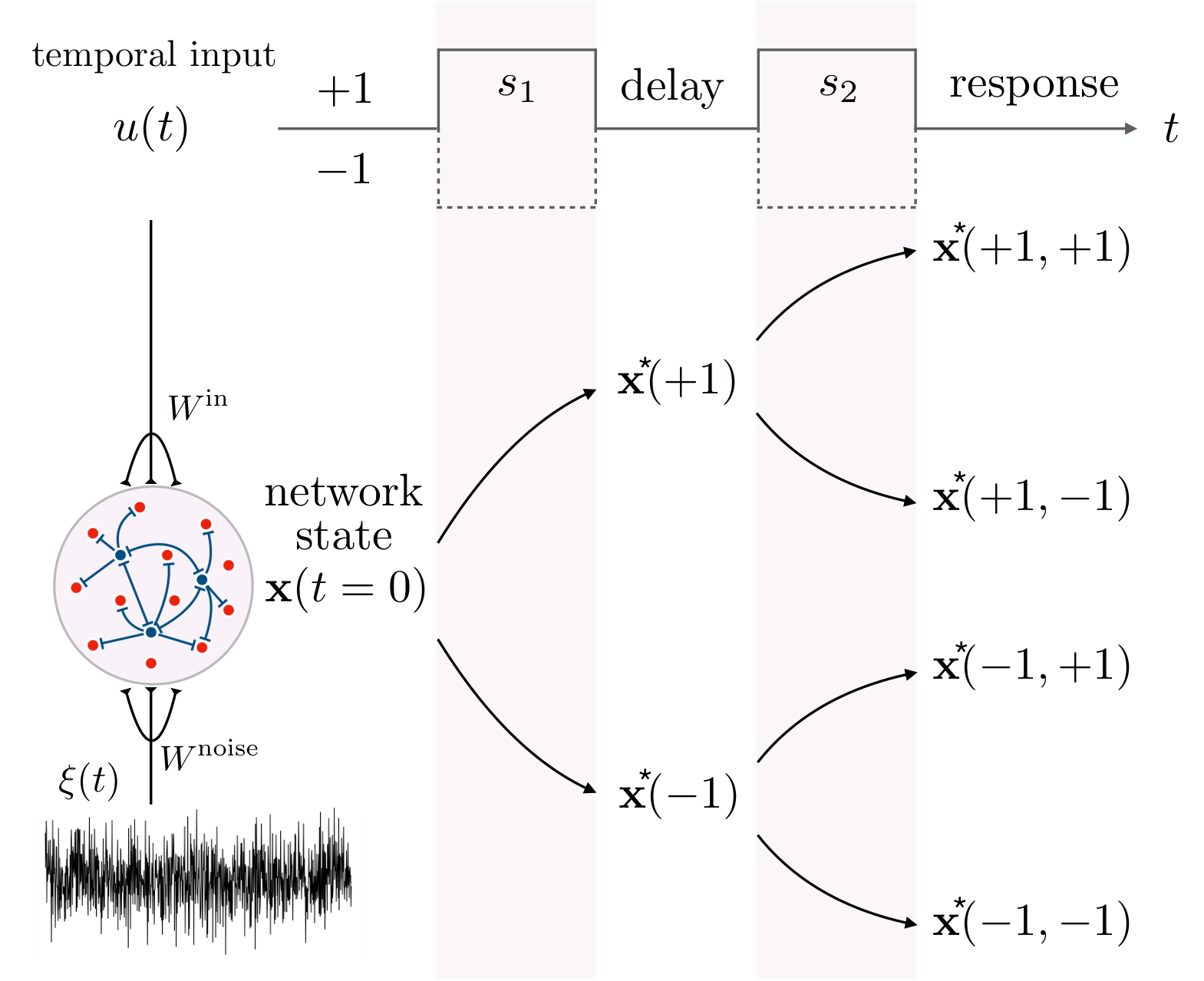
A recurrent network retains the first binary cue in one of two states, then branches into four states after the second cue.
Sequential memory as a driven-dissipative dynamics transitioning between marginally stable nonequilibrium steady states.Figure 1, Chotibut, Evnin & Horinouchi, SciPost Physics (2026), Random matrix theory of sparse neuronal networks with heterogeneous timescales.
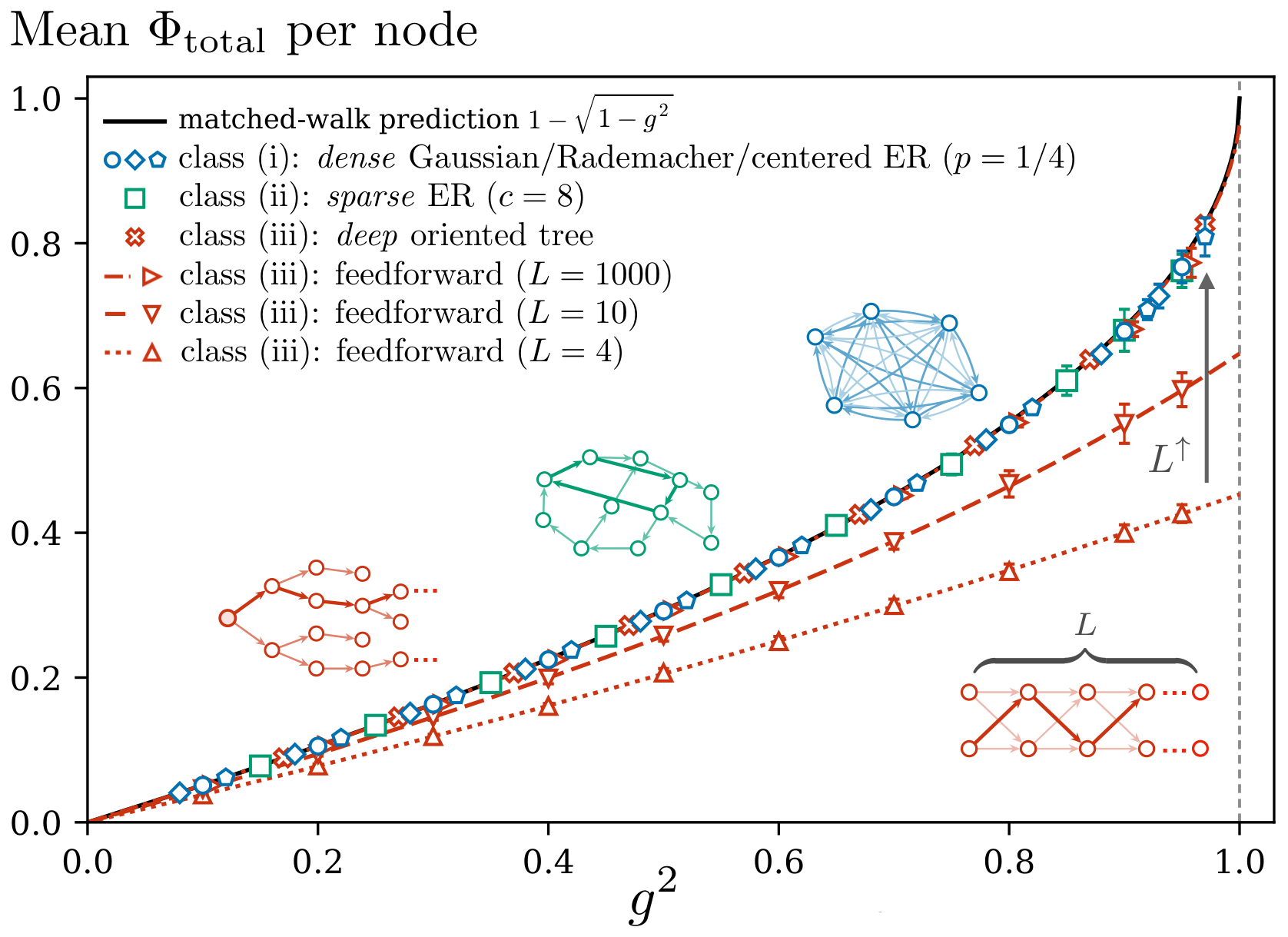
Mean entropy production per node versus interaction strength for dense, sparse and acyclic networks. Finite-depth feedforward curves approach the square-root prediction as network depth increases.
Disparate interaction network architectures dissipate at the same universal rate in the large network limit.Figure 1, Chotibut, Gudowska-Nowak & Nowak, arXiv:2608.25030 (2026), Directed walks shape a universal square-root law of entropy production rate in nonreciprocal systems.

Neuronal dynamics · Temporal memory · Edge of stability

Robust sequential memory in noisy neuronal networks

Experimental neuroscience counterintuitively finds that mice with noisier cortical areas perform working memory tasks more effectively. Using computational surrogate models, we show that sparse, asymmetric network structures and heterogeneous synaptic timescales help the network to utilize an attractor-hopping mechanism to express sequential memory under noisy conditions. Supersymmetric methods for non-Hermitian random matrices reveal that such network structures possess attractors operating near the edge of stability. Memory is thus reliably retained in non-equilibrium steady states, yet remains responsive to input drives due to their marginal stability.

There is also a link to thermodynamics of computation here; sustaining memory in a nonequilibrium steady state requires continuous energy dissipation. We show how directed walks within any interaction networks shape dissipation, revealing a universal law of entropy production across disparate random networks.
T2

Quantum information processing

Quantum systems often defy efficient classical simulation and information extraction. A central question is how to exploit natural quantum dynamical processes for information processing with minimal measurement requirements, particularly in classically intractable regimes, to achieve practical quantum utility.

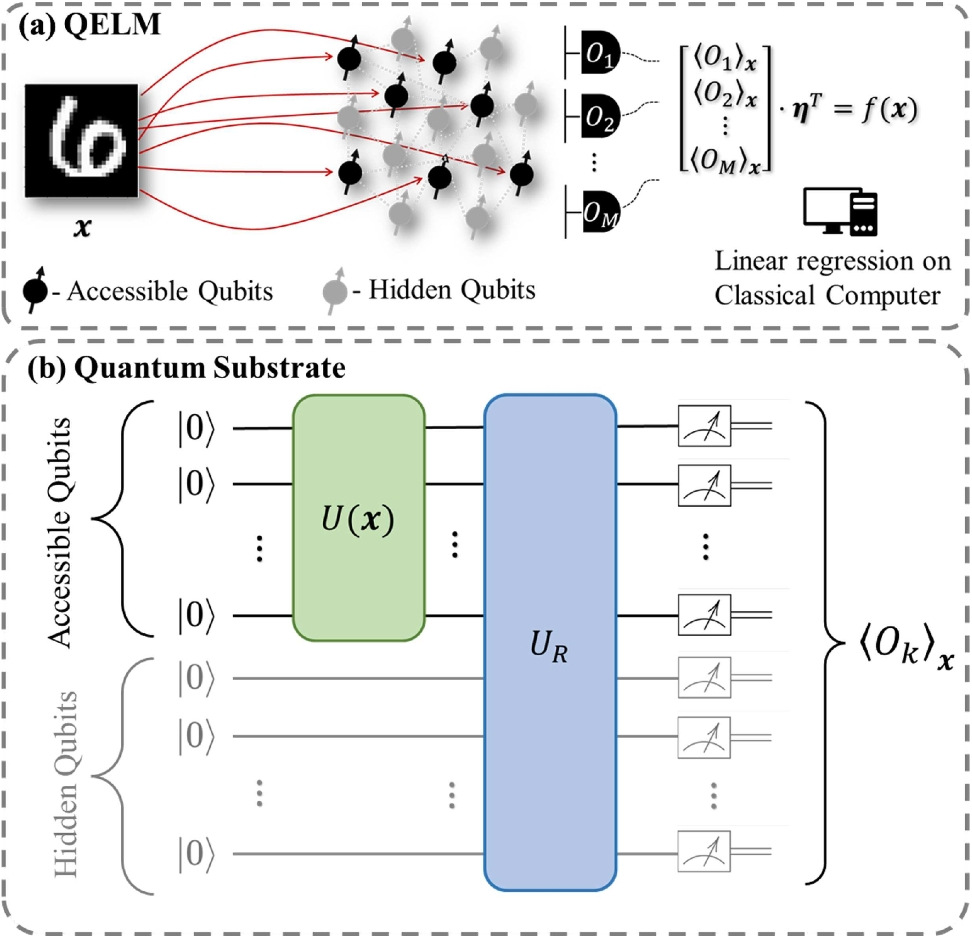
Quantum extreme learning framework: inputs are encoded into a quantum system, evolved and measured, then combined by a trained classical readout.
A fixed quantum substrate (reservoir) responds to an input drive; the response is extracted by quantum measurements. These readouts are further used to train machine learning models classically. Figure 1, Xiong et al., Quantum Machine Intelligence (2025), On fundamental aspects of quantum extreme learning machines.
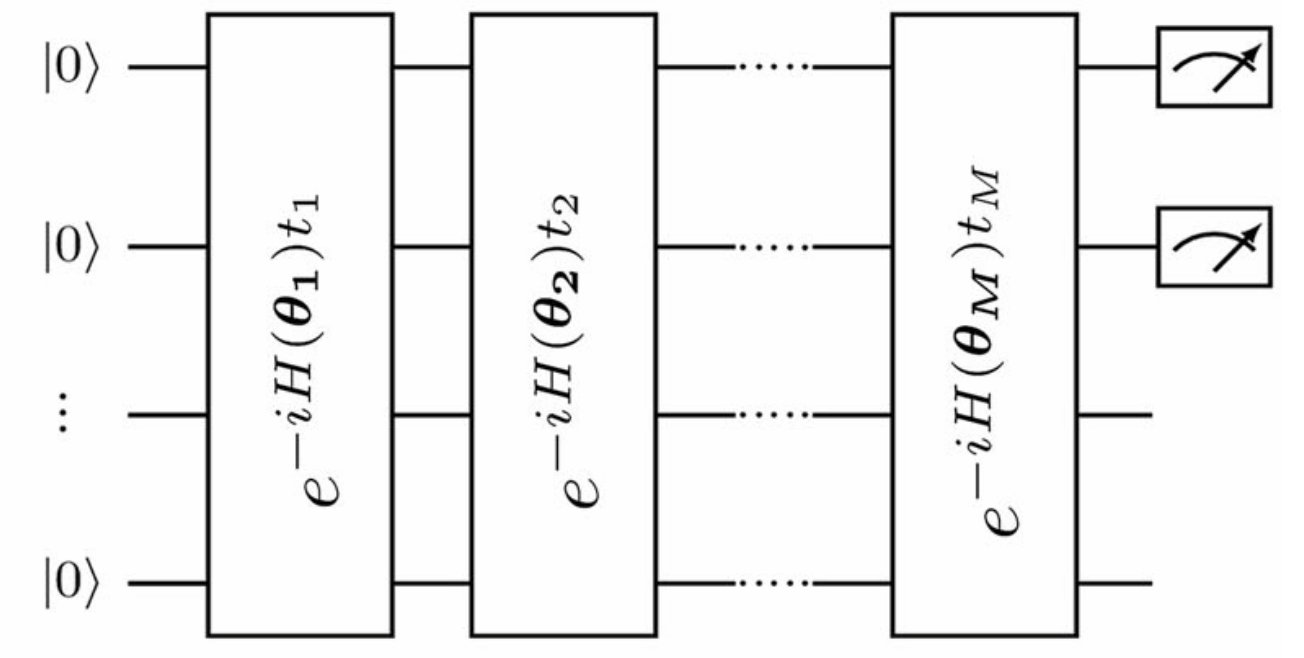
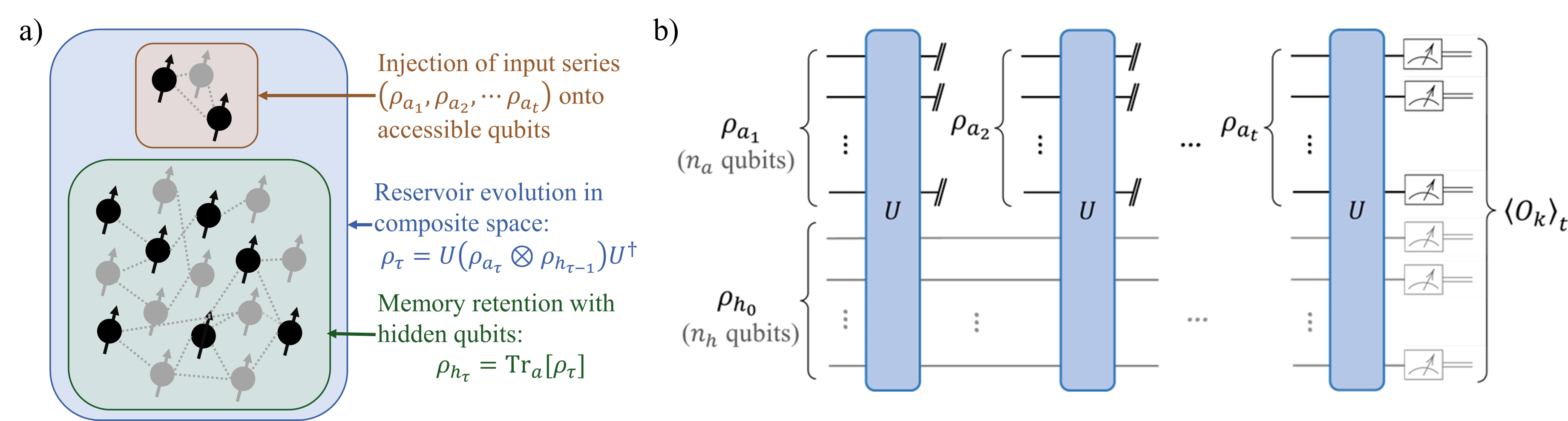
Quantum reservoir processing framework and circuit diagram: inputs are loaded into accessible qubits, while hidden qubits retain memory between successive reservoir evolutions.
Quantum reservoir processing (QRP) repeatedly loads inputs into accessible qubits, while hidden qubits retain memory of earlier inputs through coupling to a fixed quantum reservoir evolution. This approach is typically used for temporal information processing with quantum systems.Figure 1, Xiong et al., Role of scrambling and noise in temporal information processing with quantum systems (2025).

Quantum machine learning · Quantum reservoir processing

Expressivity of quantum reservoir processing at scale

Quantum extreme learning machine (QELM) and quantum reservoir computing process inputs using a fixed quantum evolution and train only a simple classical readout. This approach makes the native quantum dynamics part of the computation.

We investigate the expressive power of these models and the conditions when they lose predictive capability at scale. Information scrambling, noise, and the choice of quantum measurements make different inputs increasingly difficult to distinguish with finite shots as the system size grows. There is thus a tradeoff: predictive power beyond classical simulability comes at the cost of an exponentially large number of shots. This phenomenon is analogous to barren plateaus in variational quantum algorithms.

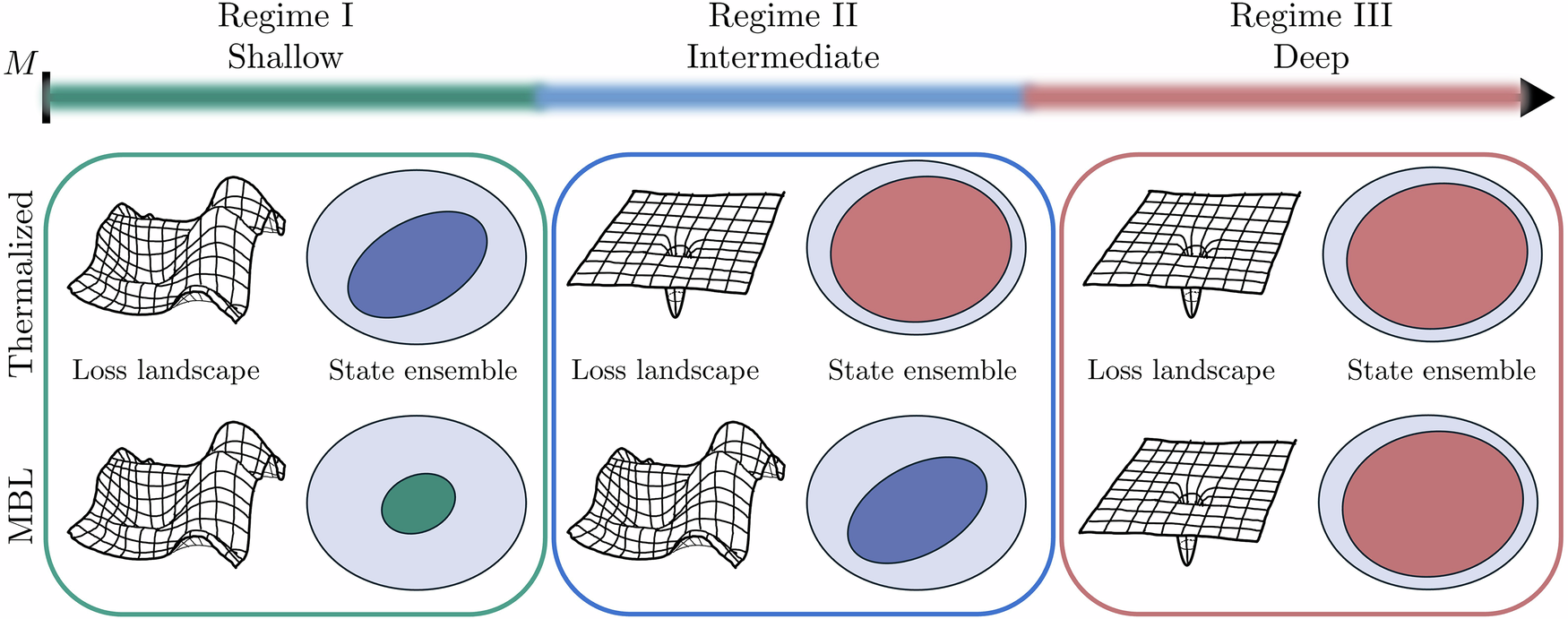
Diagram comparing loss landscapes across circuit depths and initial quantum phases, including many-body localization and thermalization.
Different quantum phases of matter affect how the training loss landscape of analog variational quantum algorithms changes with the evolution time (circuit depth). Figure 2, Srimahajariyapong, Thanasilp & Chotibut, Communications Physics (2026), Connecting phases of matter to the flatness of the loss landscape in analog variational quantum algorithms.

Many-body physics · Quantum optimization · Analog VQA

Quantum phases of matter shape training loss landscape

Analog variational quantum algorithm (VQA) is an experimentally feasible approach to realize quantum optimization algorithms using native quantum dynamics. By exploiting the physics of many-body localization (MBL), analog VQA can be trained at initialization at scale, unlike thermalized phases whose quenched evolutions suffer from untrainability (an exponentially flat optimization landscape). This concept is parallel to expressivity-induced barren plateaus and warm-start initialization strategy in gate-based VQAs.

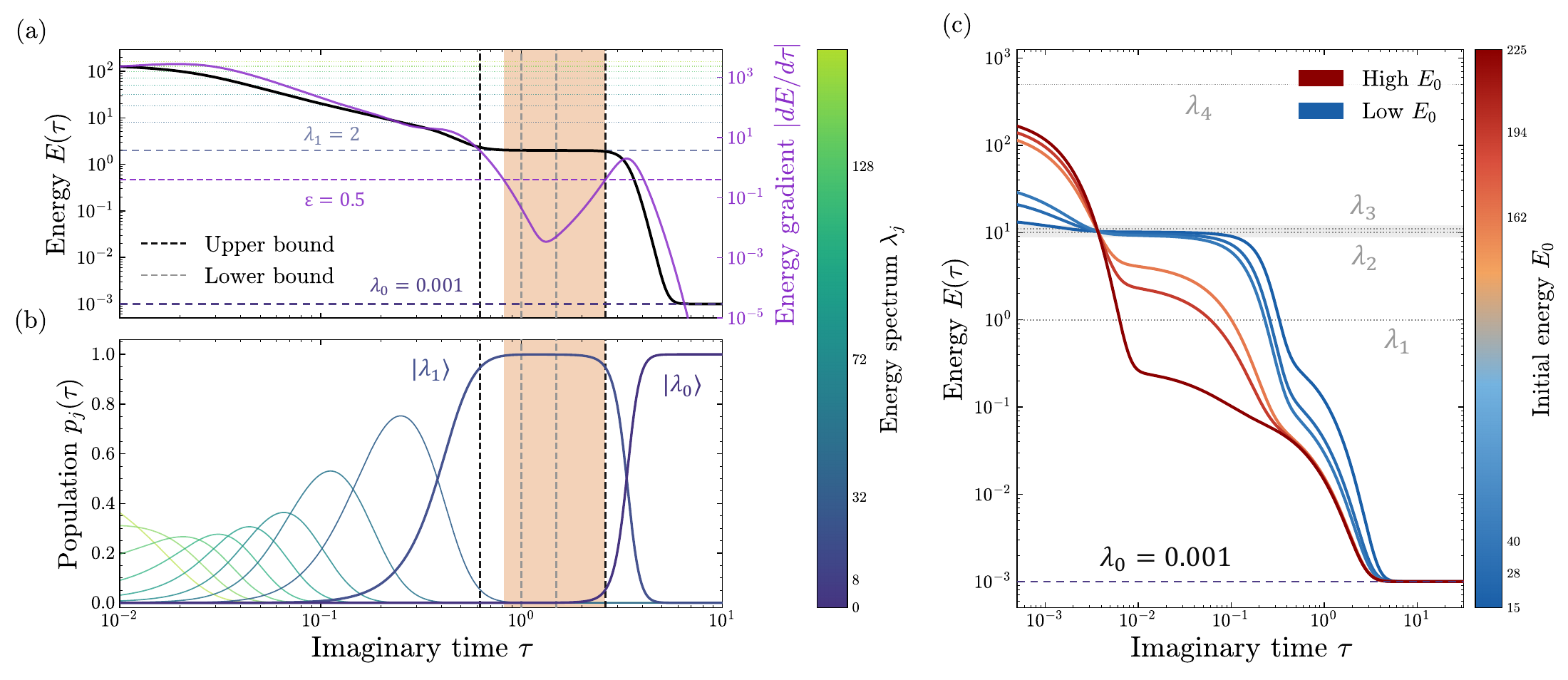
Figure 1 of the ITE manuscript: energy and energy gradient plateau near an excited state while eigenstate populations reveal false convergence; a third panel compares cooling from different initial states.
Although there is an asymptotic convergence guarantee for ITE, its transient evolution can stagnate for some times near an excited state. A small energy gradient there can signal false convergence while ground-state fidelity remains low.Figure 1, Stagnation and false convergence in imaginary-time evolution (To appear).
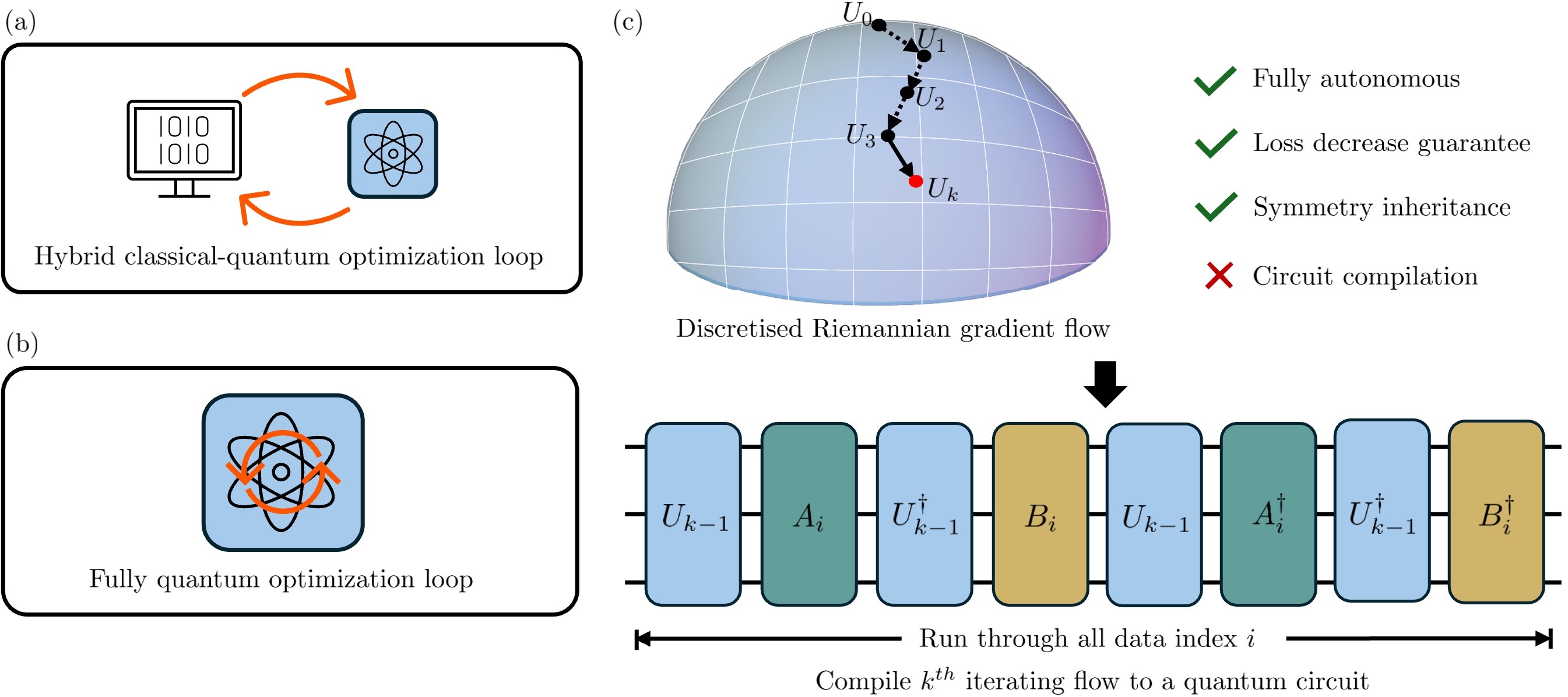
Figure 1 of the DBQA manuscript compares hybrid and fully quantum optimization loops and shows Riemannian gradient flow compiled into a sequence of quantum gates.
Hybrid (a) versus autonomous (b) quantum machine learning, with Riemannian gradient updates compiled into quantum circuits. We identify sufficient conditions where full autonomy (in optimization) holds.Figure 1, Autonomous quantum machine learning via Riemannian gradient-based optimization (To appear).

Quantum machine learning · Coherent quantum optimization

Scalability of quantum optimization protocols beyond VQAs

The scalability barriers in VQAs fundamentally arise from quantum-to-classical information extraction, namely the exponential concentration of observable readouts leading to exponentially vanishing loss gradients. A crucial question is then: Can we design efficient, coherent protocols for optimization and learning without a quantum-to-classical feedback loop? We investigate two such approaches.

Imaginary-time evolution (ITE) suppresses high-energy components of a quantum state and thus provides an alternative for ground-state preparation and optimization. We show that even when this energy-filtering process can operate coherently on a quantum hardware, ITE is fundamentally limited by stagnation and false convergence phenomena, where energy decay can slow down and stagnate near some excited states. Overcoming these limitations would allow ITE to accelerate optimization protocols.

Riemannian gradient descent follows directions of steepest descent that respect the geometry of unitary transformations. Such unitary updates can be approximated by quantum circuits from double-bracket quantum algorithms. For suitable loss functions and with access to the required quantum operations, this provides an autonomous quantum machine learning framework in which training proceeds coherently without intermediate quantum measurements or classical feedback. This approach can perform quantum phase classification and unitary learning that exploits symmetries inherited from the training data without explicitly imposing them. A central challenge is circuit depth, which grows rapidly with the number of training iterations.

To appear onlineStagnation and false convergence in imaginary-time evolution
To appear onlineAutonomous Quantum Machine Learning via Riemannian Gradient Optimization
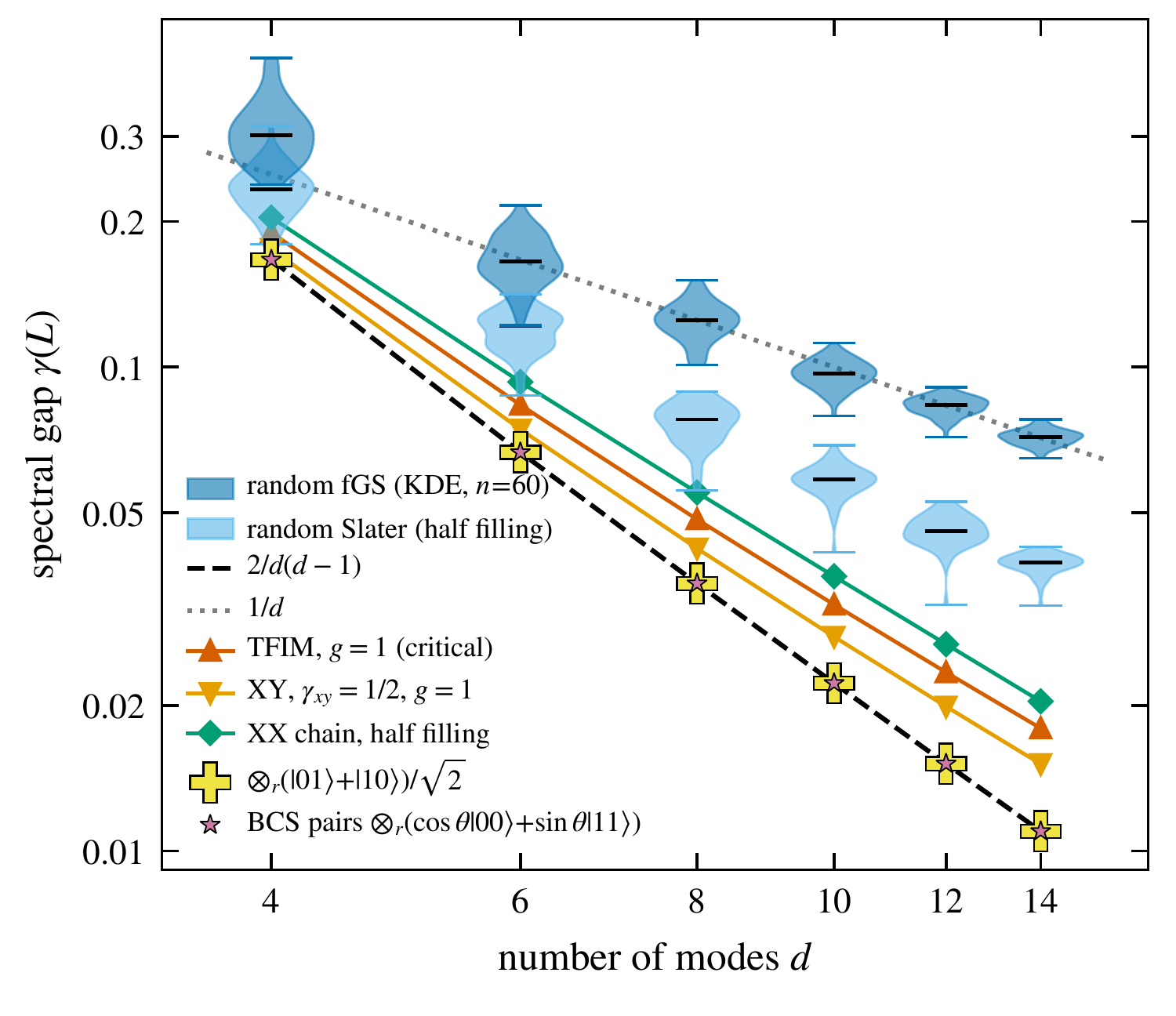
Spectral gap of the certification walk versus fermionic mode count, showing distributions for 60 random Gaussian and Slater states per size, spin-chain ground states, and paired-state families saturating the worst-case bound.
Spectral gaps of the certification walk for random fermionic Gaussian states, Slater determinants and spin-chain ground states. Paired-state families saturate the worst-case bound, while larger gaps imply shorter relaxation times and fewer copies needed for certification.Figure 1, Dangniam, Premcharoen, Sripech & Chotibut, arXiv:2609.28233 (2026), Certifying fermionic Gaussian states (and a little more) with optimal precision dependence.

Quantum verification · Fermionic Gaussian states

Quantum state certification

Reliable quantum information processing requires confidence that a device has prepared the targeted state. Full many-qubit tomography is generally impractical, motivating certification tests with rigorous guarantees. We study certification of pure fermionic Gaussian states, including Slater determinants and BCS pairing states, which are important reference states for quantum simulations of electronic structure and many-body physics. Building on the certification protocols of Huang, Preskill, and Soleimanifar, we develop a protocol using single-qubit measurements that achieves optimal sample complexity scaling of 1/ε, with the allowed infidelity ε at fixed system size and confidence. The analysis relates this sample complexity to the inverse spectral gap of an associated classical Markov chain, and connects fermionic Gaussian state certification to relaxation toward equilibrium in networks.

T3

Collective dynamics in multi-agent systems

We study emergent simplicity (or complexity) in many-body interacting systems, from swarmalators to multi-agent adaptive populations.

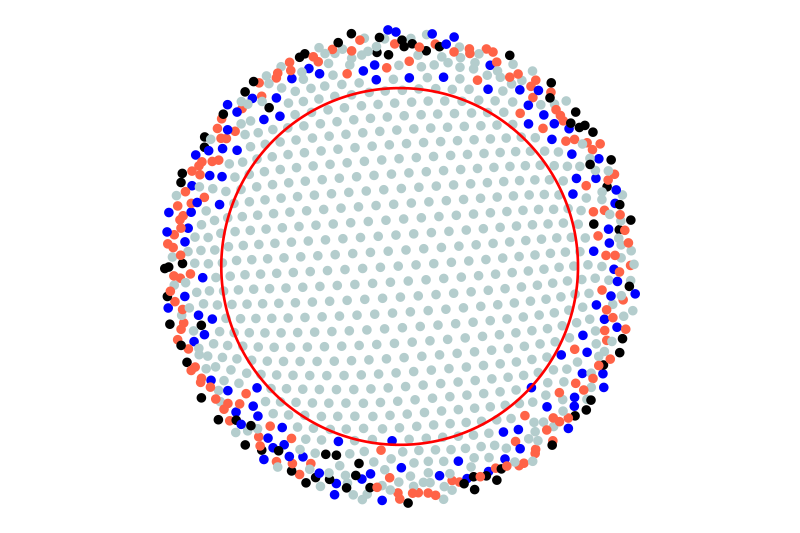
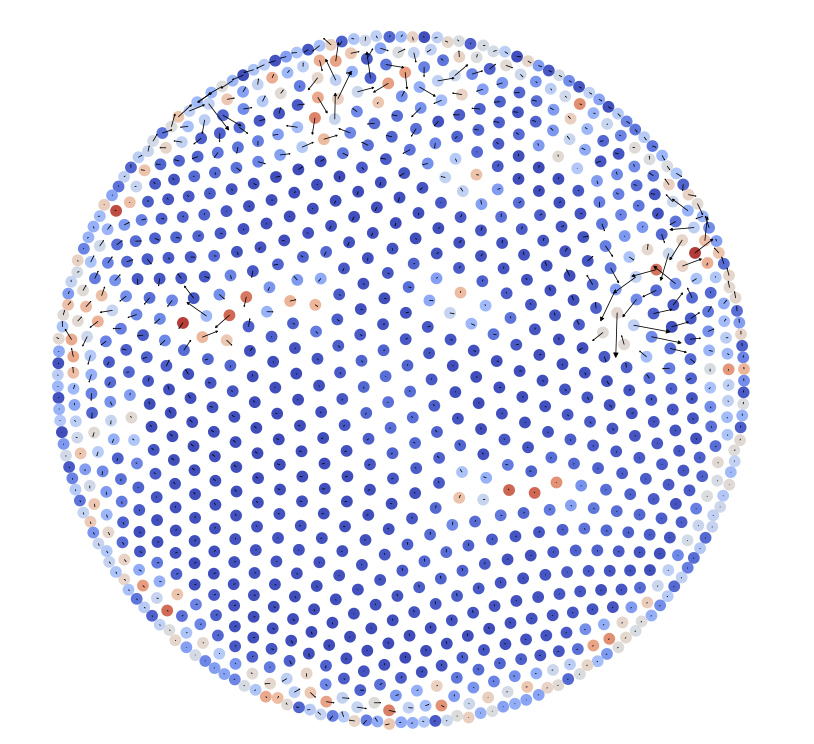
An ordered swarmalator crystal with a pale teal core and a surrounding layer of moving, differently coordinated particles.
Self-organization of a two-dimensional crystalline core surrounded by a fluctuating boundary in a delayed-swarmalator system.Figure 10, Kumpeerakij, Chotibut & Kogan, PRR (2026), Aging in a two-dimensional swarmalator crystal with delayed interactions. Watch swarmalator videos
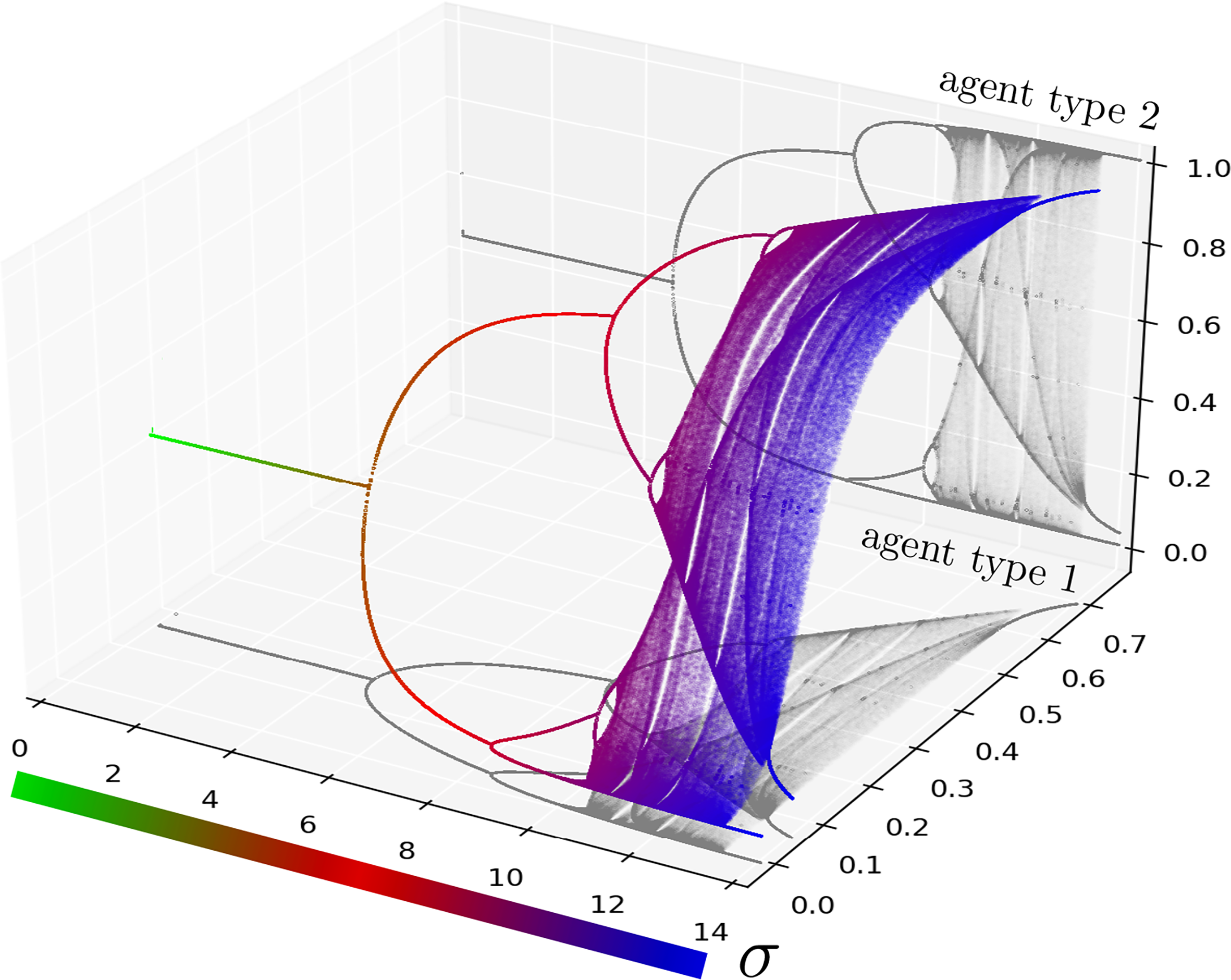
A three-dimensional bifurcation diagram showing how the long-term choices of two agent types become unstable and chaotic as their learning rates increase.
As the learning-rate scale σ increases, two agent types with different adaptation rates pass through bifurcations into unstable or chaotic dynamics. Gray projections show each type’s long-term choices.Figure 2, Bielawski, Chotibut, Falniowski, Misiurewicz & Piliouras, PNAS (2025), Heterogeneity, reinforcement learning, and chaos in population games.

Collective dynamics · Between order and chaos · Multi-agent systems

Finding order in complex dynamics

Collective dynamics can be simple even when many interacting agents retain a memory of the past. Swarmalators (swarm + synchronized oscillators) couple spatial motion to an internal oscillatory degree of freedom, and delayed interactions can lead to two-dimensional bulk crystallization through aging phenomena. We study how delayed swarmalator systems eliminate topological defects and create self-organized crystalline order.

Collective dynamics can also be complex and chaotic when agents retain a full memory of the past. We study population routing games in which agents may differ in their initial beliefs and reinforcement learning rules. Faster learning and adaptation can destabilize Nash equilibria and generate chaotic, unpredictable collective dynamics. Strikingly, the time-averaged fraction of the population choosing each strategy converges to its Nash-equilibrium value. There is thus hidden order in this population chaos: a static Nash equilibrium survives on average beneath complex agentic behavior. Feigenbaum's universal route to chaos in this non-unimodal map class is also reported.